There are two main types of lubrication during operation of motors with rotating devices. One is called "hydrostatic",
if the axles are lubricated by additional pressure applied to the oil in order to lubricate the
axles. The other is called "hydrodynamic", if the rotating parts will lubricate themselves by developping
enough dynamic pressure to the oil, adhered to the rotating parts.
Following there are some explanations how the hydrodynamic lubrication works and can be affected.
To evaluate the friction between two surfaces moved relative to each other a dimensionless factor, called
"coefficient of friction" or more simple " number of friction". The formula-symbol is the greek
small mu m.
The size of this coefficient is dependent of the rotational rate. Thus it's value varies, depending which type of
friction is present, as shown in the following picture, where m is plotted as a function of
the rotational rate (normated to n=nü' for some reason). This curve is called "Stribeck-curve":
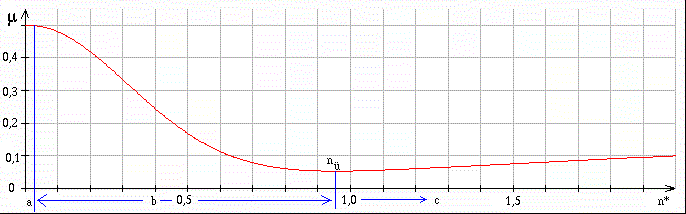
Stribeckkurve
The curve is split into three areas, which are defined as follows:
- Area "a" as solid-solid friction, with m = const
- Area "b" as mixed friction with m = steadily decreasing
- Area "c" as liquid-friction with m = linear increasing
Regarding this plot one finds a minimum, the corresponding rotational rate is defined as "rotational rate of transition"
and shows the point, where the solid-solid-friction is no longer dominating over the liquid-friction. The formula-symbol
of this value is nü. However, the normation is made to a value a bit higher, named nü'. This value
corresponds to the rotational rate, where the solid-solid-friction is de jure zero.
One might ask, which circumstances are participating to give the absolute values. The following list shows the main contributions:
- dynamic viscosity h of the lubrifiant
- The gradient of the Stribeck-curve within the range of liquid friction depends on the viscosity of the lubrifiant.
At low (high) h-values nü is relatively large (small).
Thus, liquid friction (LF) is reached at high (low) rotational rates. LF is wanted in order to avoid soon wear off of the
bearings and axles. Ergo, lubrifiants with low (high) viscosities are best for high (low) rotational rates
- surface pressure within the bearing
-
The higher the pressure within the bearing, the higher the rotational rate needed to reach the LF. This affects directly
the behaviour and needs to the lubrifiant: the higher (lower) the pressure within the bearing, the higher (lower) the
mandatory viscosity of the lubrifiant to reach the LF at the same rotational rate.
- Charcateristics of the surfaces in bearing and axle (material and "mean roughness")
-
The absolute maximum of m is 0.5 (according to the theory of Treska). However,
in normal cases this value isn't reached (e.g. the pair steel/steel has a mmax = 0.15
for static friction). So any pair of material has individual maxima.
Further, this maximum value also depends on the surface conditions. If the value of mean roughness increases, also the influence
of the solid-solid friction to m increases. But the latter is a function of the
rotational rate which itself affects the space between bearing and axle via the dynamic pressure. But exactly this
pressure influences the amount of solid-solid-friction. Thus a pair of materials having low mean roughness-values will
produce less friction at a given rotational rate, than a pair having larger values of mean roughness. To reach
nü (LF), it is mandatory for high (low) values of mean roughness to have high (low) rotational rates.
Since we are regarding solid-friction, the viscosity of the lubrifiant has no effect at the first sight.
1892 visitors since 01.06.2008